Earlier this year Bandcamp released a statement banning music that was generated ‘wholly or in substantial part by AI.’ As a track I generated myself with AI puts it, in a weirdly melancholic, unprompted tone: A line was drawn in the digital sand, a gate was closed by a human hand…What’s the art? What’s the tool? Who makes the heart? Who makes the rule?
The announcement may not be as devastating as my generated ballad makes it out to be, but it’s the firmest stance we have seen adopted in the music industry. The ban also comes with user flagging and a right to remove any suspicious tracks to complete the package. I believe this stance deserves analysis, so alongside my personal thoughts I spoke to producers, a label owner and an AI music founder to get their perspectives on the topic. This write-up is the product of those conversations.
This is not a hit piece against generative AI, nor am I a complete technophile. I have sought to look at the arguments impartially and in doing so I have identified two key strands: one is a question of money, the other taste. Let’s start with the money.
A common argument against generative AI is that it was trained on data that it did not pay for. Robbie, the founder of the jungle label N4HC, puts it more bluntly, ‘it’s f*cked up.’ He goes on to note that AI music companies have committed piracy to train their models on a scale never seen before. Hacked material recently revealed to 404 Media, an independent news agency, validates Robbie’s anger. Suno, one of the largest AI music models, built a file titled ‘youtube_music’ which, since it was last updated, had ingested ‘2,013,545 music clips.’
The actions of Suno are part of a wider trend of AI companies training their models on dubious legal grounds. The New York Times is taking action against OpenAI for the use of millions of articles without authorisation. Several authors recently won a landmark case against Anthropic for its use of pirated shadow libraries such as LibGen, which hosts millions of copyrighted books. The prevailing attitude amongst AI companies seems to be take now and ask (or pay) for forgiveness later.
The music industry is also taking action. The Recording Industry Association of America (RIAA) which represents the Big Three of Sony, Universal and Warner has sued Suno and another AI company, Udio, for mass copyright infringement. Last month Sony filed a second, separate suit against Udio asserting over 30,000 of its recordings were used without its consent. The potential statutory damages could exceed $4.5 billion, equivalent to the GDP of a small country.
A closer look at these cases, however, reveals a more nuanced picture. Big record labels are settling with AI music companies and then immediately getting in bed with them. Warner settled with Suno in November last year. Suno then acquired Songkick, a Warner company. After their own settlement, Universal and Udio announced they are jointly launching a ‘music creation, consumption and streaming’ service.
Unfortunately the financial benefits behind these deals does not seem to be trickling down to actual artists. This is evidenced by another lawsuit filed by the American Federation of Musicians against Universal and Warner. It claims the labels did not trigger the ‘new uses clause’ in the union’s collective bargaining agreement, circumventing the need to reimburse musicians when signing new deals with companies such as Suno or Udio. Artists therefore continue to be left out of the loop.
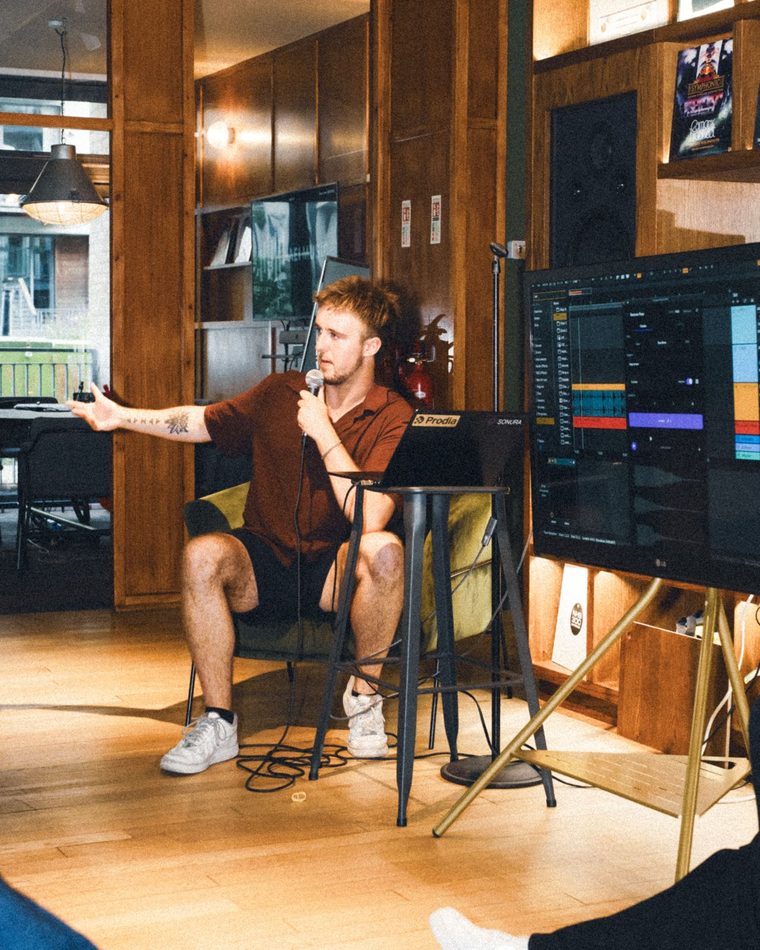
Some AI companies have shown that it does not need to be like this. I spoke to Kindred Salway, founder of Sonura, an AI-native music studio. Sonura in turn runs through ElevenMusic, a model trained on exclusively licensed data provided by the label rights body Merlin and publisher Kobalt. Artists signed under those companies can opt in to have their data used and if they do, they receive financial compensation. Kindred is keen to distance himself from other startups that have chosen growth over everything else: ‘We’re here to build tools for you and not to steal from you.’
Another producer I spoke to remained skeptical, doubting that any revenue sharing scheme would make a ‘meaningful impact.’ For the vast majority of the music ecosystem which is not signed to the Big Three or some other licensing infrastructure, there is no compensation scheme at all. If you can find your work somewhere in Suno’s 2 million music clips, you have effectively been robbed. From the money point of view, Bandcamp’s ban makes a lot of sense.
Slop is the Merriam-Webster Word of the Year for 2025. In the context of this article, it's used to describe music that has been generated with minimal prompting or thought. This creates a track that is devoid of originality and not particularly good, even by the music world’s subjective standards. The track I produced from a single prompt for the purpose of sprucing up this article, definitely does not belong on Bandcamp. They say the soul is something you can’t code…
Music that is produced in part by AI, however, poses a different question. Robbie notes that AI tools can help lower the high entry barriers to complex programs such as Ableton and FL. Another producer found AI generations to be a useful placeholder to stop an idea from being lost. They could then go back and design the sound themselves. Stem splitters are also becoming more popular, allowing producers to sample music in new ways.
Can generative AI be seen as a technological continuation of sampling? For Kindred it potentially is. He suggests that working with a model that you have significant control over is actually ‘closer to creativity than reaching for a Splice loop.’ For Robbie, however, the creativity of sampling stems from giving something old a new lease of life, a process that is blurred by generative models rather than enhanced. Neither argument is wrong in my eyes.
Despite the growing use cases for AI in music production, it remains a real taboo for artists. One track getting a lot of publicity at the moment is Rubberz by Fenix Flexin. As a west-coast hip hop artist, his productions are typically defined by heavy 808 sub basses and lyrics to match it. Take the opening verse of his mixtape released in 2021: Fenix Flexin, ain't a doubt I'ma bless the b*tch (ayy, ayy).
On Rubberz, however, Fenix takes a completely different creative direction. Inspired in his own words by rock bands such as The Cure and The Smiths, he sings with a British accent over a light New Wave beat that wouldn’t be out of place in a Duran Duran track. References to ass and money are replaced with a relaxed nod to plastic smiles on sunset boulevard. Rubberz peaked at 58 on the top 100 billboard.
After two months of denial the rather obvious truth came out, Fenix had used a generative platform called Treblo AI. His producer, Purps on the Beat, remains unapologetic, arguing in an interview that ‘technology is the guidance of what music is going to sound like.’ He placed AI alongside other evolutions such as synthesisers, digital tools and autotune that were initially received with outrage, but are now accepted as standard practice.
Another musical act coming under fire recently is Two Shell, an electronic music duo that played last year at Glastonbury’s famous IICON stage. I personally had the pleasure of seeing them perform at London’s Venue MOT a few years ago (see video below). In an interview with Resident Advisor they echoed Purps’ point, describing AI as ‘just another instrument, really.’ The comments from fellow artists were scathing. Mentioning the use of AI in your creative process seems to be terrible advice for any aspirational musician.
Bandcamp’s statement falls in line with this anti-AI sentiment. They claim the ban will ensure ‘fans have confidence that the music they find on Bandcamp was created by humans.’ This seems to ignore the point that Two Shell are two humans in a studio. No matter how generated Rubberz is, it needed the input of Fenix and Purps. Bandcamp’s policy comes across to me as dismissive and heavy handed in a space I like to think of as forward thinking and rule breaking.
The indignation of the music world is in many ways justified. AI platforms like Suno and Udio have robbed human artists and as they sign deals with big music, they have effectively gotten away with it. Slop is also bad with tracks that are saturating music streaming services, radio airwaves and potentially the charts as well.
To return, however, to Bandcamp’s ban that helps ‘musicians keep making music.’ This rules out an artist exploring and producing thoughtful and interesting music on an AI model that uses licensed data. In this way, both the money and the taste argument feel redundant, but Bandcamp has not left any room for this.
Bandcamp is a platform whose core mission is to help underground artists make money from their music. The revenue argument therefore takes on a more important dimension and I get it. Perhaps their statement should be rewritten as ‘keeping revenue human’ because startups such as Kindred’s Sonura are unfortunately not the norm.
Ultimately, it's worth coming back to Purps on the Beat: ‘Music is subjective as f*ck, which is dope.’ I expect this debate to rumble on for a long time and so it should.